 ipPulse™
What is ipPulse?
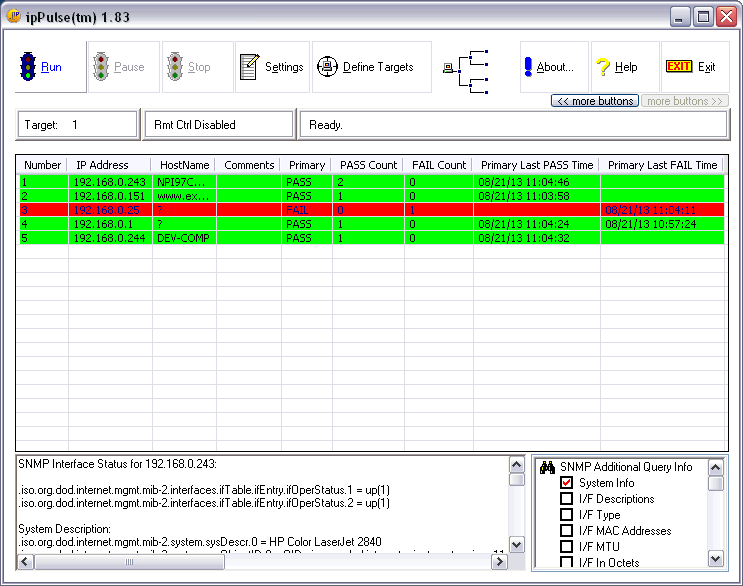
ipPulse™ is a Connectivity and Device Status Monitoring
Tool. Use ipPulse to monitor the connectivity status of IPv4 connected
devices (computers, routers, switches, printers) on any IPv4
connected network. ipPulse can use one or two tests
including ping, TCP Port connection, or SNMP to poll and
check the network connectivity of your list of devices.
ipPulse alerts you to failures using several methods ranging
from audible messages to email notification - send alert
emails to your phone. Logging to a text file is supported.
Download
Free 30 day Trial Now!
How to Install
ipPulse
Unzip and run ipls19x.exe. Follow the directions in the installation utility. Uninstall is supported from Control Panel.
How to Uninstall ipPulse
Use Control
Panel/Programs and Features. More detailed instructions
are here.
 1 License - $69 USD
5 Licenses - $320.85 USD
Monitoring Test Methods used by ipPulse
Each IPv4 address can be tested with a Primary Test and an optional Secondary Test.
**The web page test is new in v1.90 and allows for a different page retrieval (or no page) for each target. It supports both http and https page retrieval along with non-standard web server ports.
Notification Methods: when a failure occurs, there are several user-configurable things it can do:
- Primary test can Ping the target to see if it responds or connect to a TCP port* to see if the connection is accepted.
- Secondary test has four modes: disabled, connect to a TCP port* to see if the connection is accepted, use SNMP v1/v2c to find out if a network interface is down or connect to a web server**, retrieve a web page, check the web server status code and optionally check the visible or hidden text in the page for a specific string that is always supposed to be present.
**The web page test is new in v1.90 and allows for a different page retrieval (or no page) for each target. It supports both http and https page retrieval along with non-standard web server ports.
Notification Methods: when a failure occurs, there are several user-configurable things it can do:
- Email Notice - supports sending mail through both secure (TLS) and unsecure email servers.
- Audible Beep or play a WAV file.
- Logging to a text file.
- Logging to a web page.
- Launch an external program on failure with command line parameters.
More about ipPulse
Click on the tabs below to learn more about ipPulse.
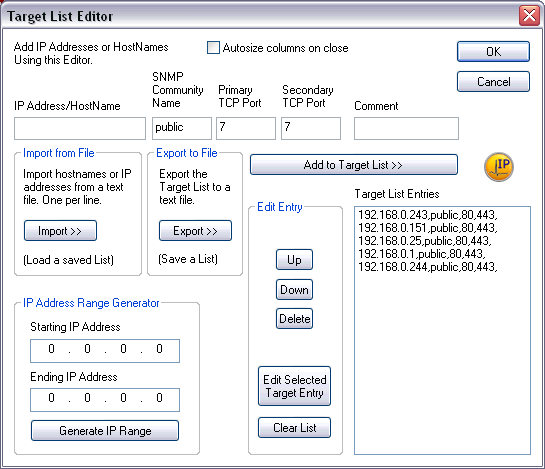
- Supports a large list of target hosts entered as either hostnames or IP addresses. The list can be imported from a text file.
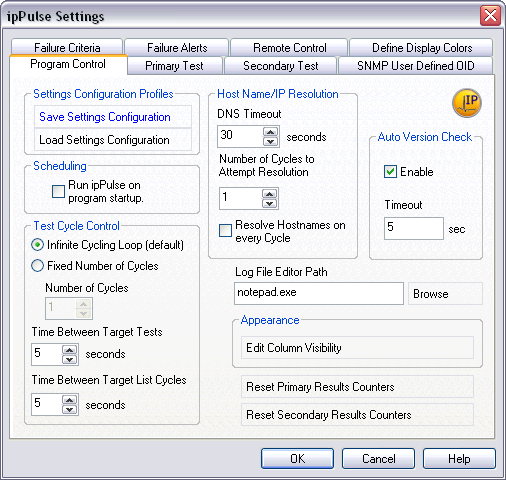
- Polls the list on a cyclical basis with full control over the list cycle timing parameters.
- Supports a primary and secondary test.
- Supports standard Ping (ICMP Echo Requests/Replies). Primary test only.
- TCP Port numbers for TCP connect tests are assignable on a per-node basis. Primary or secondary test.
- Optional Web Server Page Test (secondary test) that can retrieve a web page (plain text http or secure https), check the web server status codes and optionally check for a presence of a specific string either in the visible or hidden page text. Web server status codes or absense of string can trigger an error message.
- Optionally uses SNMP v1/v2c as a secondary test by requesting MIB2 ifOperStatus for every interface found on the target node. Community names are assignable on a per-target basis.
- Optional SNMP queries can be made for obtaining more extensive data from the target host. ipPulse includes a number of OID presets and 12 user defined OIDs. Example: you can obtain MAC addresses for every interface from an SNMP enabled host.
- Multiple alerts and logging. Alert options include beeping your computer, playing a wave file, notifying someone by email, or sending an email to a cell phone. Logging options include logging all test results to a text file, logging only errors to a text file, or logging errors to a dynamically created HTML page. Any combination of logging options can be used. Alerts are issued upon failures using user-defined criteria. Changes from a FAIL state to a PASS state can generate email messages.
- Email notification via the SMTP protocol with the server of your choice. It supports standard SMTP messaging (no authentication), SMTP AUTH Login and STARTTLS (TLS) messaging.
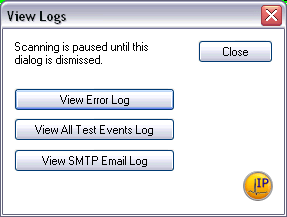
- Remote Control allows you to view log files and start, pause or stop a scanning cycle. Remote Control is password protected and can be accessed on user defined TCP port. It is disabled by default.
- All documentation is contained in a local help file (press F1).
- Requires Windows 10, 8.x, 7 (32/64 bit), use on Server requires GUI. Does not support earlier versions of Windows.
- Requires TCP/IP network connection and DNS if you are using hostnames instead of IP address targets.
- Requires minimum 1024 x 768 display.
- ipPulse can be set to run on program startup.
- Licensed on a single computer system basis. You can monitor an unlimited amount of target nodes (within technical limitations of the program) from your licensed copy.
Download Free 30 day Trial Now!
Looking for Alternate Download Sites?Are you upgrading?
Do you have an old CD version? Please visit this page for more information and alternate download sites.
Installation Instructions
Unzip and run ipls19x.exe. Follow the directions in the installation utility. Uninstall is supported from Control Panel.
Downloading Problems?
The zip file size is exactly 3,632,376 bytes. Did you get a different size when downloading with Internet Explorer? Then try using Chrome or Firefox.
Code Signing
The ipPulse installer and executable application components are code signed with SHA1 and SHA256 for your protection.
Pricing: The cost for a single license unlock code is $69 US.
The Buy Now link below goes to our authorized reseller FastSpring.
FastSpring